The Smoke
Trail
Three cities, three arguments about what barbecue is. You drive west and south until the pork turns to beef, the sauce disappears, and the plate becomes a sheet of butcher paper.
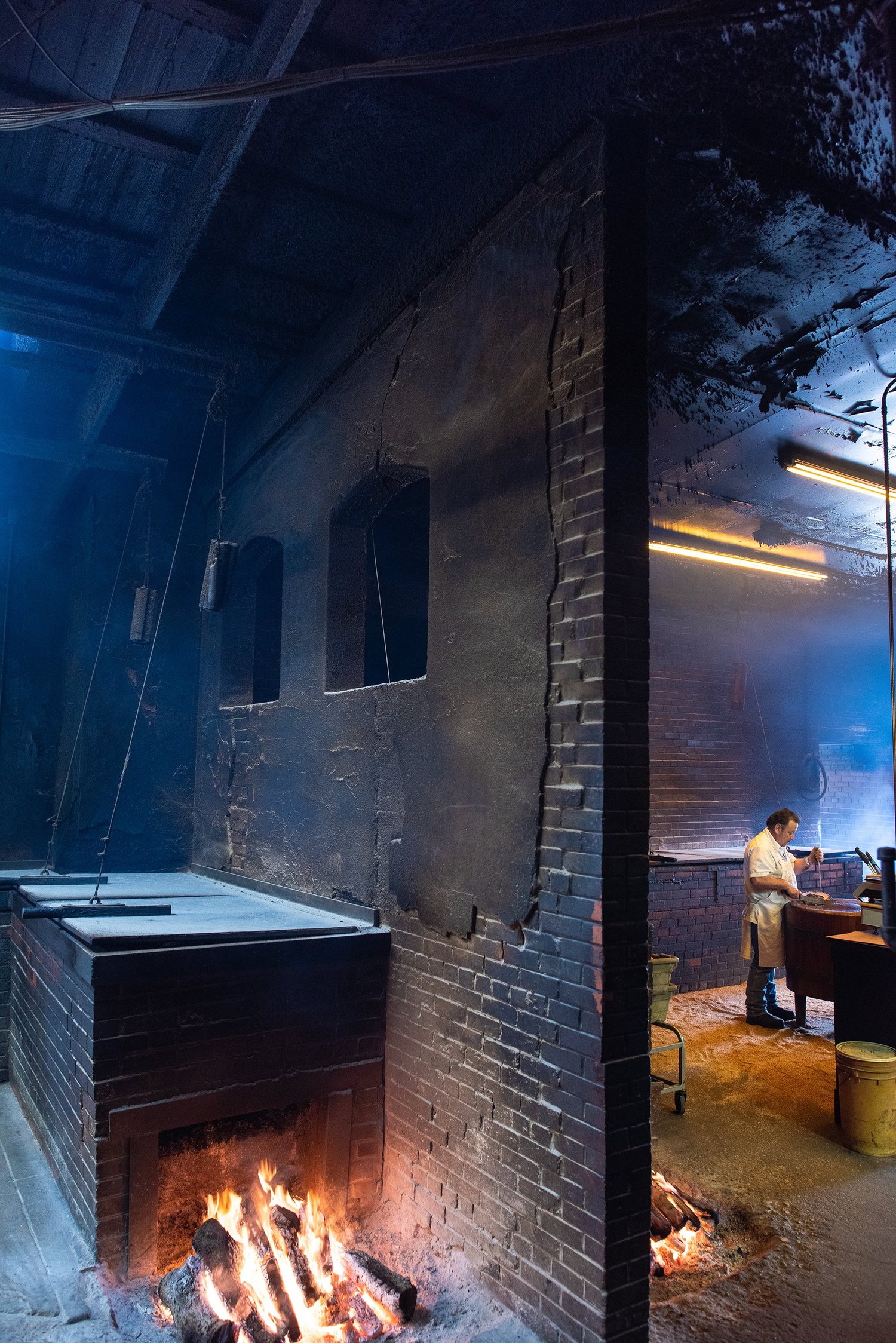
You will smell every one of these places before you see it. In Nashville it comes off 4th Avenue South at eleven in the morning — hickory and a whole hog that has been on the coals since five. In Memphis it hangs in a brick alley off Monroe, so thick that the sign for Charlie Vergos' Rendezvous is almost unnecessary; you just follow it down the stairs. And 640 miles later, in a low room in Lockhart, Texas, the smoke is not a smell at all but a temperature: post oak coals burning a few feet from your ankles while you stand in line, the ceiling above you black with a century of soot, no forks and no sauce anywhere in sight.
Between those two rooms lies the most interesting eating corridor in America. This is not one cuisine repeated three times — it is three separate traditions with different animals, different woods, different arguments, and different manners, laid out conveniently along an interstate. Nashville is the crossroads that invented its own bird. Memphis is a pork city that turned a spice rub into a civic religion. Central Texas is German and Czech butcher shops that never quite stopped being butcher shops. Drive it in order and the story tells itself.
What March gives you
The best month on this route, and not a close call. You are past winter and well before the Southern summer turns eating outdoors into an endurance event — Memphis in July is a different trip entirely. Crowds are thin everywhere except Austin.
Mornings are cold enough for a jacket everywhere — Nashville lows sit in the upper 30s to mid 40s°F, and Hill Country mornings run 40s–50s. Afternoons are patio weather by Memphis and genuinely warm by Austin. The catch is rain: March is one of Tennessee's wettest months, roughly ten or eleven rainy days, and the Arkansas–North Texas stretch of the drive sits in serious spring severe-weather country. Pack a shell, not an umbrella, and check the forecast before the long haul day.
The March payoffs beyond weather: Nashville's Yoshino cherries around Public Square Park and Centennial Park peak in the last week or so of the month, Memphis Botanic Garden runs its BLOOM season with a million bulbs, azaleas and tulips are out at Garvan Woodland Gardens in Hot Springs, and Austin's bats begin returning from Mexico under the Congress Avenue Bridge. Texas bluebonnets are the one thing you may miss — peak is late March into mid-April, so early-March fields will be green.
The single highest-leverage decision on this trip is which weekday you begin. Memphis's three most iconic pits are closed at the start of the week: Rendezvous opens Wed–Sat, and both Cozy Corner and Payne's run Tue–Sat. Start on a Monday and the itinerary below puts you in Memphis Wednesday night through Friday morning, with all three open. Start on a Saturday and you will spend your Memphis days looking at locked doors. The trade-off is that your Austin finale lands on a Sunday — fine for Franklin and la Barbecue, but be in Lockhart early, because Smitty's closes around 3 pm on Sundays.
The route, and how long it takes
Nashville to Austin is about 1,250 miles the way this guide drives it. The first leg is nothing; the second is the whole point of splitting the trip in two.
| Leg | Drive | Nights | Why |
|---|---|---|---|
| Nashville | — | 2 | Whole hog, hot chicken, and the densest live-music strip in America |
| Nashville → Memphis via the Natchez Trace | 3 hr 10 min direct on I-40 · 5–7 hr with the detour | — | Biscuits, a double-arch bridge, and a village where Grammy winners play open mic |
| Memphis | — | 2 | Dry rub versus wet, the Lorraine Motel, Sun Studio, a real juke joint |
| Memphis → Hot Springs | 3 hr 30 min | 1 | Breaks a brutal 9–10 hour haul in half; adds a national park and a soak |
| Hot Springs → Austin | 7 hr | — | Texarkana brisket, Czech kolaches, and the state line where pork becomes beef |
| Austin + Lockhart | 45 min to Lockhart | 2 | The modern canon, then the butcher shops it all came from |
Seven days, in order
- 1
Nashville
Land, drop the car in a garage, and walk. Whole hog at Martin's for lunch, Lower Broadway at dusk, Robert's Western World when the bands hit their stride.
Mon · no driving - 2
Nashville
Drive north to Shotgun Willie's for Texas-style brisket before it sells out, the Ryman and the Hall of Fame in the afternoon, hot chicken for dinner, East Nashville after dark.
Tue · 40 min of driving - 3
Nashville → Memphis, the long way
Biscuits at Loveless Cafe, the Natchez Trace double-arch bridge, lunch in Leiper's Fork, an hour on Franklin's Main Street, then west to Beale Street.
Wed · 5–6 hr with stops - 4
Memphis
Payne's or Cozy Corner by noon. The National Civil Rights Museum and Sun Studio in the afternoon. Dry ribs at the Rendezvous, then Wild Bill's late.
Thu · 30 min of driving - 5
Memphis → Hot Springs
Out early. Arkansas whole hog in Little Rock, a century of secret sauce at McClard's, then Bathhouse Row and a beer brewed with thermal spring water.
Fri · 3 hr 30 min plus stops - 6
Hot Springs → Austin
The big push. Naaman's in Texarkana for lunch — the best stop on I-30 — and kolaches at the Czech Stop in West. Arrive Austin for dinner.
Sat · 7 hr plus stops - 7
Austin, then Lockhart
South to Lockhart by 10:30 am for the pit rooms at Kreuz and Smitty's, back to Austin for the bats under Congress Avenue Bridge and a last night on Red River.
Sun · 1 hr 30 min round trip
If you can steal an eighth day, put it in Austin. It's the only way to do both the dawn Franklin Barbecue queue and Lockhart properly without one cannibalising the other.
You will park the car and leave it for days at a time — this is a walking-and-eating trip punctuated by drives. In Nashville budget $20–35 a night for a downtown garage. In Memphis the spread between a free-parking property and valet-only is $175–245 across a week, so it is worth choosing your hotel on that alone. Austin garages run $25–45 and fill during SXSW — reserve the space when you reserve the room. One genuine hazard: the Natchez Trace Parkway has no gas stations and long dead zones with no cell signal. Fill up in Nashville and download the map before you get on.
Reading the smoke
Barbecue in America is regional in the way language is regional: the same verb, conjugated differently, and everyone convinced the others are doing it wrong. Over seven days you will cross three of the great dialects. Learn to hear the difference before your first rib and the whole trip sharpens.
Memphis: pork, and a schism
Memphis is a pork city, full stop, and it is the only major barbecue town organised around a genuine internal argument: dry or wet? The dry rub was popularised in the late 1940s by Charlie Vergos, a Greek immigrant who rubbed ribs with a spice blend borrowed from his father's chili recipe and cooked them fast over charcoal in a pit made from an old coal chute. Wet ribs go the traditional slow-smoked-and-sauced route. Order half-and-half at the Bar-B-Q Shop and you get both ends of one slab — a compromise that exists nowhere else on earth. The third pillar is chopped shoulder under bright yellow mustard slaw. Wood is hickory. The city also produced two dishes found essentially nowhere else: BBQ spaghetti and BBQ nachos.
Middle Tennessee: the crossroads
Nashville never calcified one style, and that is the point — it sits on the hinge between Memphis pork to the west, Appalachian whole hog to the east, and the Texas brisket wave rolling up from the south. What it did invent is hot chicken — fried bird brushed with a lard-and-cayenne paste, served on white bread with pickles, born in the 1930s from a scorned girlfriend's act of revenge on Thornton Prince. Its other institution is the meat-and-three, which the writer John Egerton called "the great equalizer" — construction workers, judges and famous songwriters in the same line.
Central Texas: beef, salt, pepper, post oak
Then the rules invert. Central Texas barbecue is an act of aggressive restraint: brisket rubbed with nothing but coarse salt and black pepper, smoked twelve to eighteen hours over post oak until the bark goes near-black and the fat renders to silk. No mop, no baste, no sauce on the meat. It descends directly from the German and Czech butcher shops of Lockhart, Elgin and Taylor, which smoked whatever hadn't sold by the end of the week — which is why the meat still arrives market-style, by the pound, on paper. Ask for brisket moist. The sausage is hot guts.
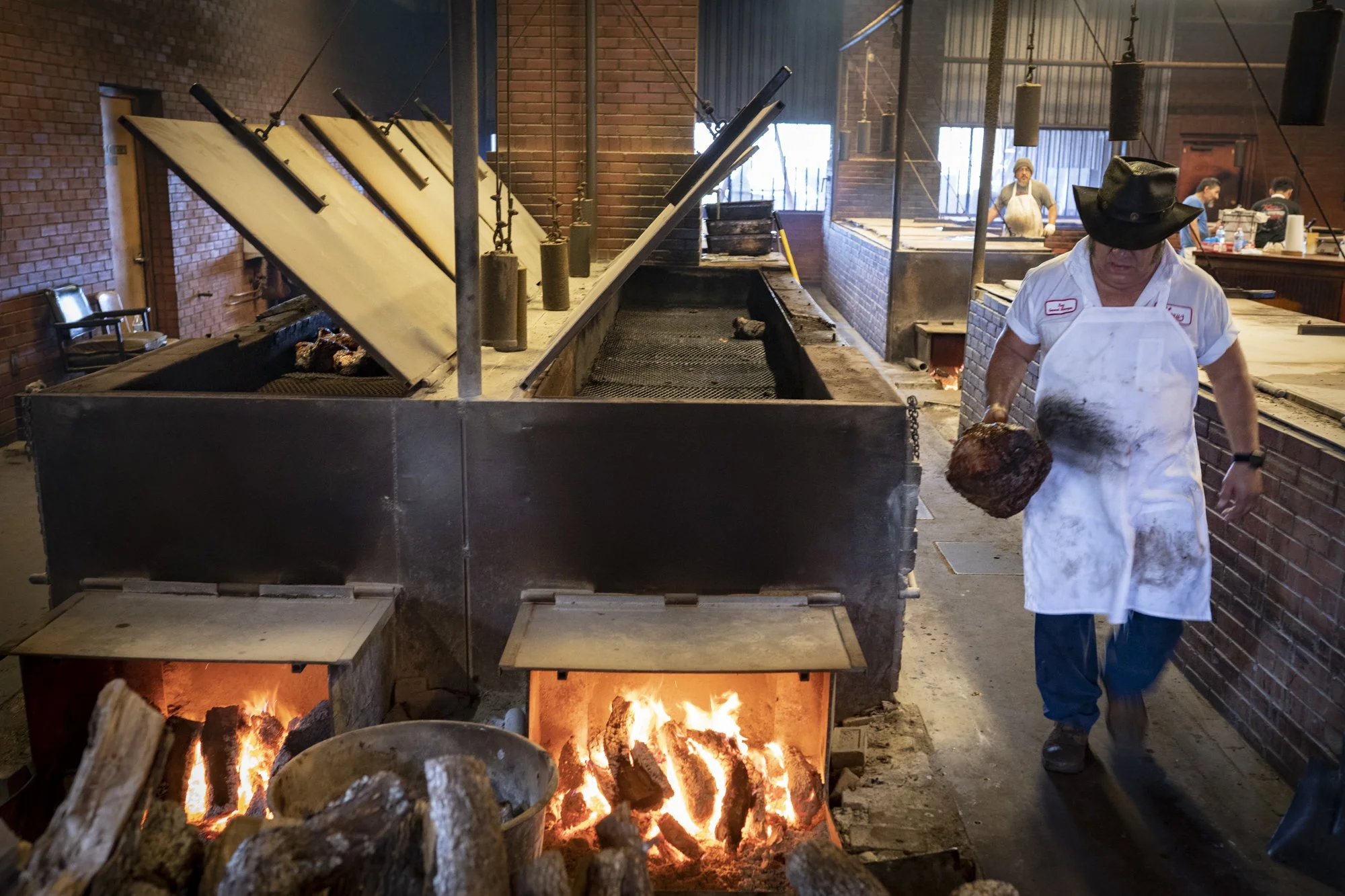
Roy Perez at the Kreuz Market pits, Lockhart — where the coals were physically dragged a quarter-mile from the original building when the family split.
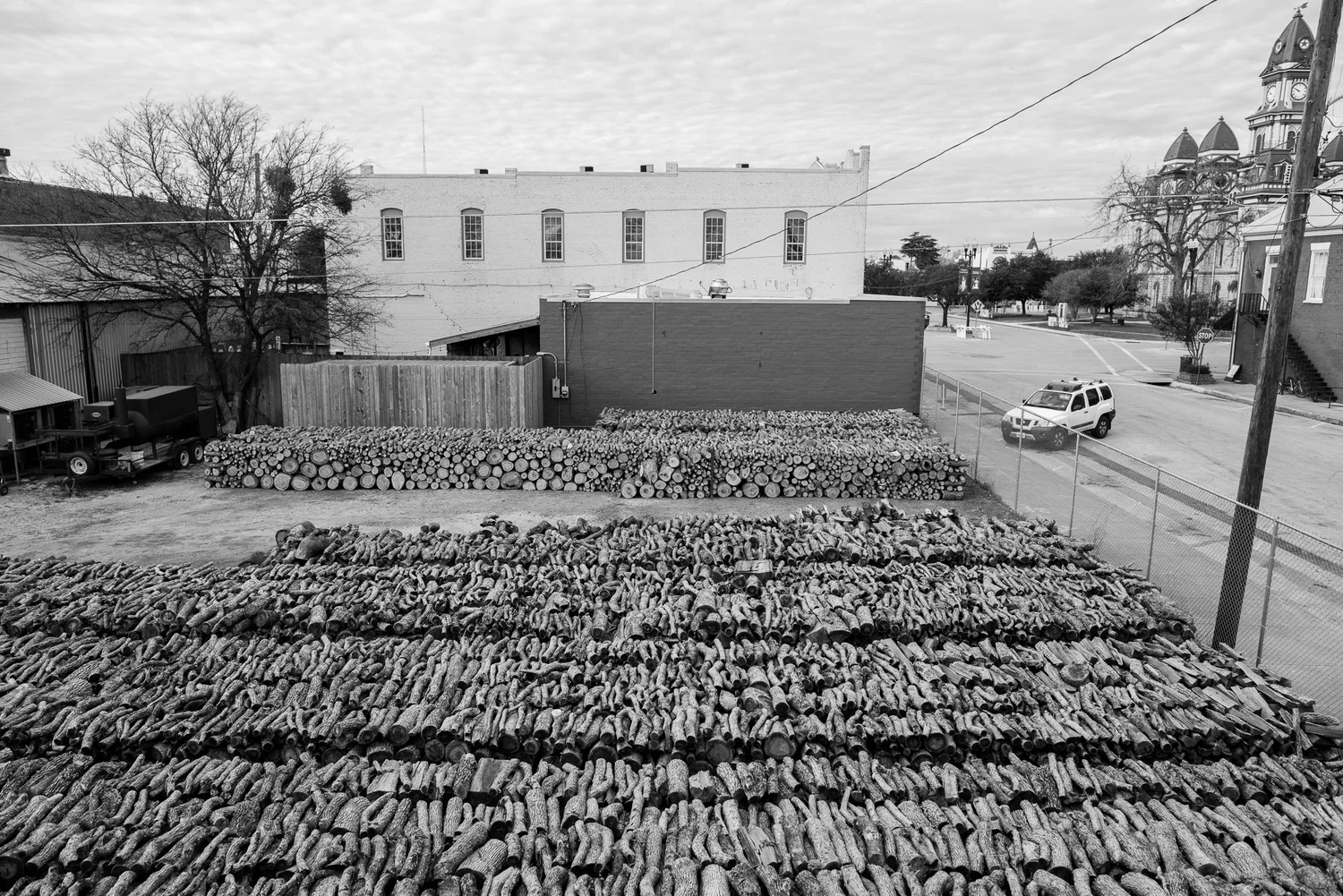
The woodyard behind Smitty's — the fuel that has kept the same brick pits alight since 1924.
| Memphis | Middle Tennessee | Central Texas | |
|---|---|---|---|
| Star meat | Pork spare ribs; chopped shoulder | Pork — pulled and chopped whole hog; and hot chicken | Beef brisket; beef ribs; sausage links |
| Wood | Hickory and pecan; charcoal at Rendezvous | Hickory, some oak and cherry | Post oak, essentially only |
| Rub | A dozen-plus spices, paprika-heavy, brown sugar | Similar — Edley's adds cayenne and habanero mash | Coarse salt and black pepper. That's it. |
| Sauce | The whole debate: dry, wet, or half-and-half | Tomato-forward and sweet; several house sauces | On the side if at all. Kreuz went a century without offering any. |
| Served | Plates and sandwiches, sides included | Plates; or a hoecake, as a redneck taco | By the pound on butcher paper; sides ordered separately |
| Manners | Forks, napkins, sauce bottles on the table | Forks; sauce on the table | Hands and a knife. No forks at Kreuz or Smitty's. Wipe on the paper. |
| Where it came from | African American pit tradition; river-trade spice | The same pit roots, plus community and church barbecue | German and Czech immigrant butcher shops |
| Found nowhere else | BBQ spaghetti · BBQ nachos · smoked Cornish hen · BBQ bologna | Hot chicken · the redneck taco · the meat-and-three | The smoke ring · shoulder clod · forearm-length beef ribs |
The sell-out clock
The one thing that will actually ruin a day on this trail is arriving at two in the afternoon. Pitmasters smoke a fixed amount overnight and stop when it's gone. This is what the day really looks like at the places where it matters.
In Memphis, say dry or wet up front and ask for sauce on the side so you taste the rub alone first. In Nashville, "medium" hot chicken is genuinely hot and anything above it is a physical challenge; the bread and pickles underneath are structural, not garnish. In Lockhart, walk to the pit counter, name your meats by the pound, take them on butcher paper, and find a seat at a communal table — sides are a separate counter. Do not ask for a fork at Smitty's or sauce at Kreuz. These are not oversights. They are the point.
Nashville
March is the sweet spot in Nashville: the bachelorette-party crush hasn't landed, rates are well below the May-to-September peak, and Lower Broadway is loud without being impassable. What Nashville does not have is one signature barbecue style — and once you accept that, the city gets much more interesting. Four traditions collide here inside about ten miles of each other, and the city's own contribution to world food isn't barbecue at all. It's a chicken leg coated in cayenne paste that will make a grown adult cry.
The pits
Start with whole hog, because it's the oldest thing here and the clearest contrast with everything that follows. Then eat brisket, so you have a Tennessee baseline for Texas.
Hot chicken Nashville's own
Not barbecue, but the most distinctive food this city has given the world, and non-negotiable. The heat is baked into the crust rather than sitting on top, it's fat-soluble, and it lingers for hours. Order medium unless you have something to prove.
What else Music City is for
The density is the thing. Bands start on Broadway at 10 in the morning and run until 3 am, seven days a week, with no cover at most rooms — and ten minutes east, across the pedestrian bridge, is where the musicians actually live and play for each other.
Broadway musicians work for tips, not a salary — the bucket matters. Strategy for a group of four: arrive mid-afternoon before the crowds, work from the riverfront end up toward 5th, take rooftop drinks at sunset, then come back after 10 pm when the bands hit their stride. But give one of your two nights to East Nashville — Dee's, the 5 Spot and the Basement East are what Broadway is imitating. Free Motown Mondays at the 5 Spot is a genuine local institution.
For the camera March
Nashville's murals cluster tightly enough to walk — the Gulch has three within fifteen minutes of each other, and 12 South has two more. The March bonus is the Yoshino cherries, which peak for only a few days in the last third of the month.
The rest of the table
One meal in Nashville should not be smoked at all. The meat-and-three is the civic lunch — cafeteria line, red tray, done by three — and it is a completely different institution from a barbecue lunch, not a substitute for one. Note that most are weekday-only.
Where to sleep
Three genuinely different trips, depending on where you put the car. For four people sharing, apartment-hotels and rental houses beat two hotel rooms on both space and price.
| Base | Best for | On the doorstep | The catch |
|---|---|---|---|
| Downtown / SoBro | Walking out the door onto Broadway with no planning | Martin's Bar-B-Que 5 min on foot; the Ryman, the Hall of Fame and Robert's all within 10 | Bass through the floor until 3 am on weekends; $20–35/night to garage the car; no supermarket |
| East Nashville | A real neighbourhood, and a house with a driveway | Curry Boys BBQ, Bolton's hot chicken, Dee's, the 5 Spot, Grimey's records | Not walkable to Broadway — car or rideshare after a long night |
| 12 South | Quiet nights on a walkable six-block strip | Edley's Bar-B-Que on the strip; Biscuit Love; the "I Believe in Nashville" mural | Least live music within walking distance; 10 min drive to everything |
Nashville to Memphis is only 3 hours 10 minutes straight down I-40 — which is exactly why you shouldn't do that. Point the car southwest instead, onto the Natchez Trace, and turn a transfer day into the best day out in Middle Tennessee.
The Natchez Trace, the long way west
The Natchez Trace Parkway starts on the western edge of Nashville and runs 444 miles to Natchez, Mississippi — no trucks, no billboards, no gas stations. You only need the first fifteen miles of it. In March the hardwood canopy is still bare, which means the overlooks give you the long views that summer leaves swallow, and the redbud and dogwood are just starting. Take the Trace as far as Leiper's Fork, eat, browse Franklin's Main Street, then cut west for Memphis. Budget five to six hours including stops; it is a genuine day out, not a detour.
-
1
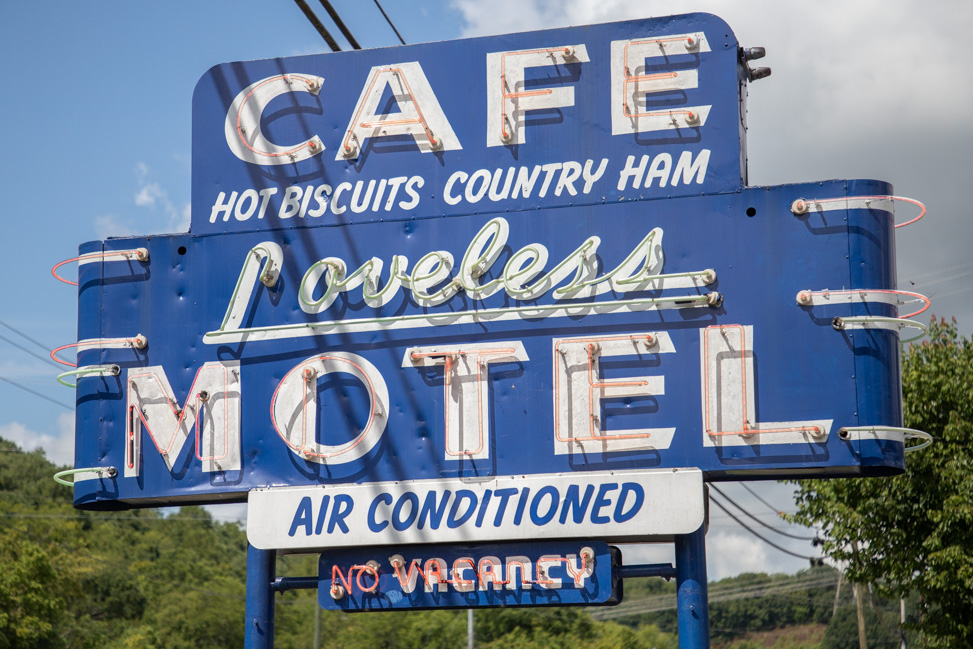
Loveless Cafe
A Nashville institution since 1951, sitting almost exactly at the Trace's northern terminus. Up to 10,000 scratch-made biscuits a day, house blackberry jam, gingham tablecloths and walls of signed photographs. They also do a creditable pulled pork.
8400 Highway 100 · opens 7 am · ~90 min · fill the tank here -
2
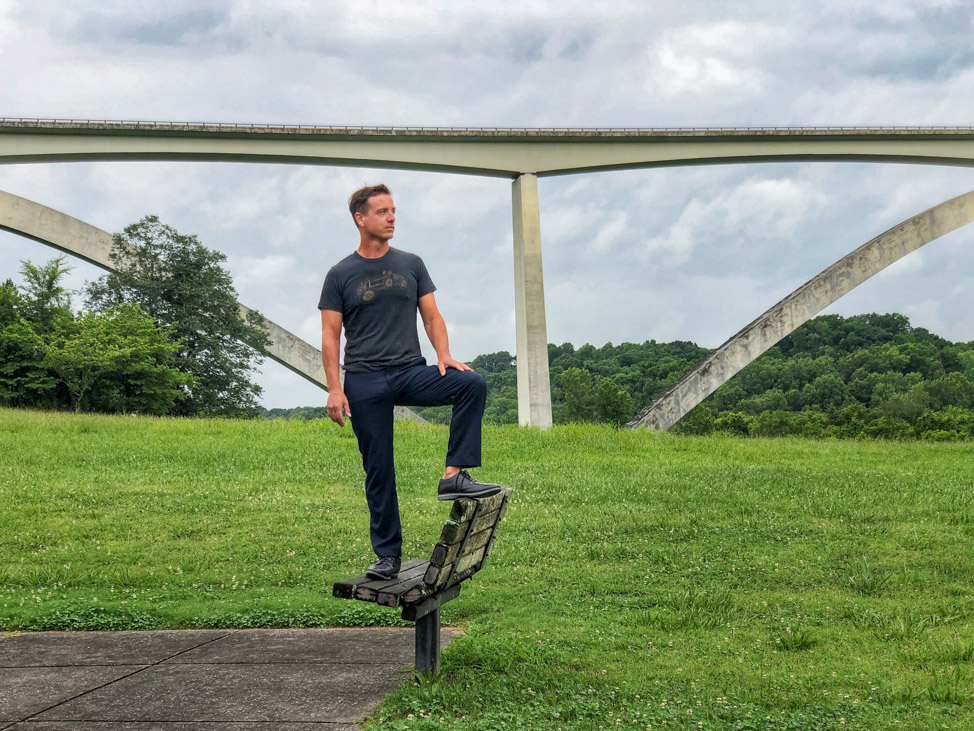
Natchez Trace Parkway Bridge
The most photographed structure on the Tennessee Trace: a double-arched concrete span soaring 145 feet over Birdsong Hollow, built in 1994 and given the Presidential Award for Design Excellence the year after. Pull off at the overlook just before it; then drop down to Highway 96 to look up at it from underneath.
Milepost 438 · free · 15–20 min · check nps.gov for closures -
3
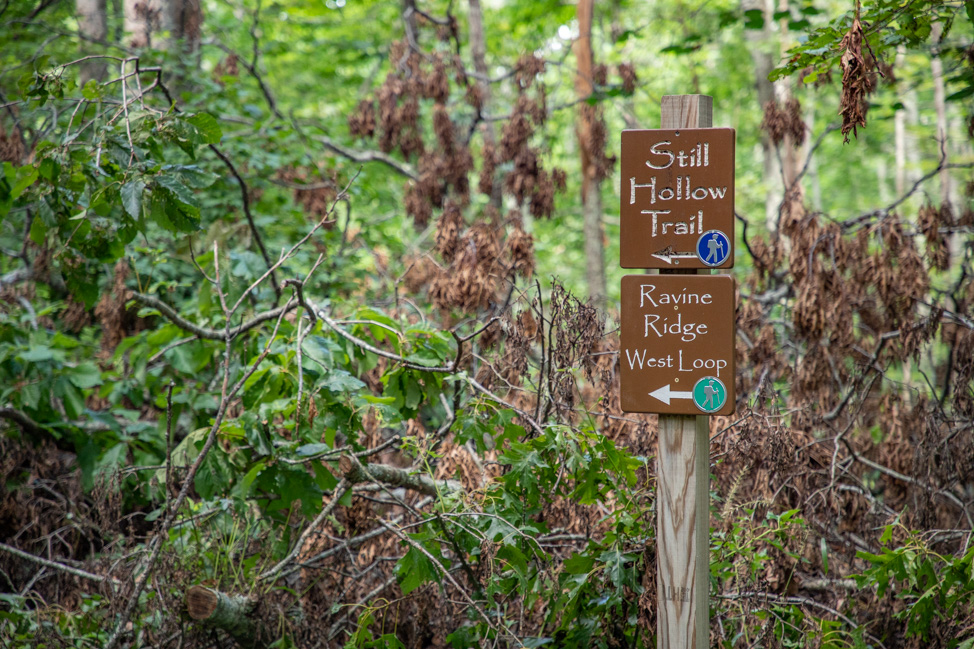
Timberland Park
Seventy-two acres immediately after the bridge — trails, a butterfly garden, an interpretive centre, and the last reliable restroom for a while. A leg-stretch, not a destination.
Milepost 437.2 · free · 30–60 min -
4

Leiper's Fork
A one-street artists' village of about 650 people, ten minutes off the Trace, with an improbable concentration of galleries and resident musicians. Lunch at Fox & Locke — a 1947 saloon in the old gas station and general store, walls of vintage radios and guitars, meat-and-three format, and a country band probably playing in front of a giant American flag simply because it's the afternoon. Its Thursday open mic is known nationally; label scouts still sit in the crowd. The original Puckett's Grocery is the more casual alternative, and Leiper's Fork Distillery pours small-batch Tennessee whiskey on a porch over the hills.
Milepost 428 · 2–3 hrs · reserve for Thursday open mic -
5
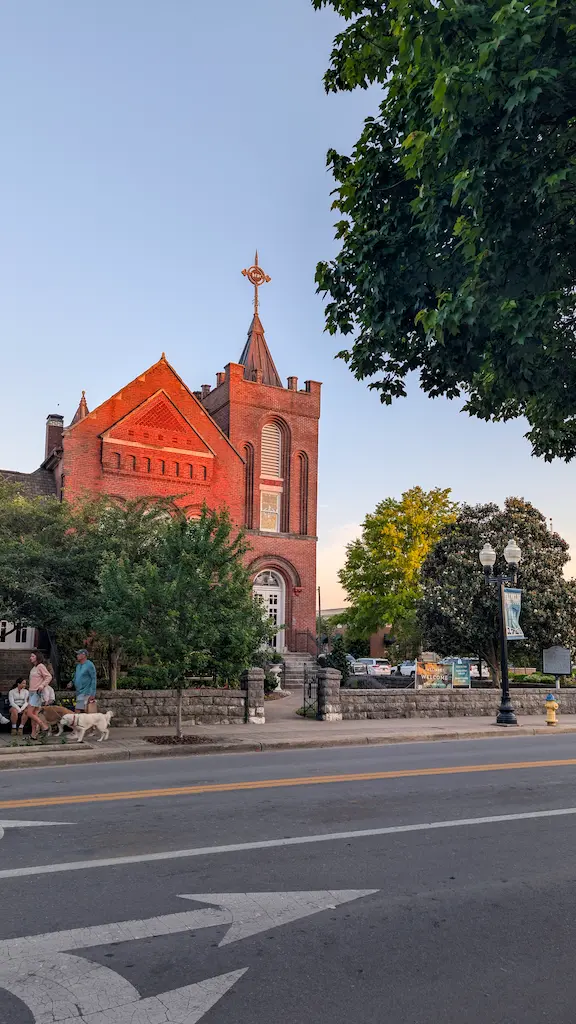
Historic Franklin
Fifteen blocks on the National Register and one of the best-preserved Main Streets in the South — 70-odd shops and restaurants in restored 1800s buildings. The square is also where the Battle of Franklin was fought in November 1864, where a slave market once stood, and where freed men later enlisted in the Union Army. Look for the March to Freedom statue, one of only six in the country honouring United States Colored Troops and the only one in a public square, and read the Fuller Story markers around it. It is a genuinely thought-provoking half-hour, not a theme park.
~2 hrs · parking free for the first 30 min · then 3 hr west to Memphis
From Franklin it is about three hours west on I-40 into Memphis. The landscape flattens, the hardwoods thin out, and you cross the Tennessee River. Aim to be on Beale Street for dinner — and if it's a Wednesday, you have just unlocked the Rendezvous.
Memphis
This is the city where barbecue stopped being a cooking technique and became a civic religion. No American city has staked its identity so completely on one food: the obsession dates to the 1820s, when the river port sat at the crossing of the Mississippi trade routes and payloads of spice, pepper and molasses met an abundance of hogs. By the 1920s pitmasters were drawing celebrities to charcoal pits, and the line from those smokehouses to today's hundred-plus joints has barely broken. But Memphis is also where Sam Phillips recorded Elvis, Cash, Perkins and Howlin' Wolf in one thirty-by-eighteen-foot room, where Otis Redding and Booker T. cut records at Stax — and where Martin Luther King Jr. was killed on a motel balcony that is now the most powerful museum in the South. Give it two full nights. It deserves more.
The pits
Four joints, three arguments, one afternoon. Do the Rendezvous and Cozy Corner back to back if you can — one grills fast over direct charcoal, the other smokes low and slow over hickory, and tasting them the same day is the clearest lesson on the whole trail. Then Payne's for the chopped-pork sandwich and the Bar-B-Q Shop for the two things Memphis invented.
Read this twice. Rendezvous opens Wed–Sat only and takes no reservations for parties under six — arrive early or queue in the alley. Cozy Corner and Payne's run Tue–Sat, and Payne's cooks only what it smoked that morning: gone by about 1:30 pm, cash forward, no exceptions. A Sunday or Monday in Memphis means missing all three. If your dates are fixed and they fall badly, Central BBQ is open daily, holds stock all day, and is genuinely good — it is the insurance policy, not the consolation prize.
Further out, and worth the drive
Three more pits that sit outside the downtown walking radius — you have a car, and each one is doing something the central four are not.
Where the music was made
You can walk most of this. Beale Street is two blocks of neon that turns into a roving outdoor concert after dark, open-container legal on the street. The real find, though, is twenty minutes north in a neighbourhood with sawdust on the floor.
One stop that is not about food
The National Civil Rights Museum is built around the Lorraine Motel at 450 Mulberry Street, where Dr Martin Luther King Jr. was assassinated on 4 April 1968. Room 306 is preserved exactly as it was; the complex extends across the street into the rooming house from which the shot was fired. The permanent exhibition traces the full arc of the movement from slavery to the present, and it is unsparing. Most visitors budget two hours and need more.
Two practical notes that matter: it is closed on Tuesdays, and timed-entry tickets should be bought online — walk-ups are standby only. Adults $25. Parking is free off G.E. Patterson Avenue. Photography without flash is permitted.
It sits two blocks from Central BBQ's downtown location and ten minutes' walk from Beale Street, which tells you something true about this city: the history and the eating are on the same few blocks, and it is worth letting them sit next to each other rather than treating one as a break from the other.
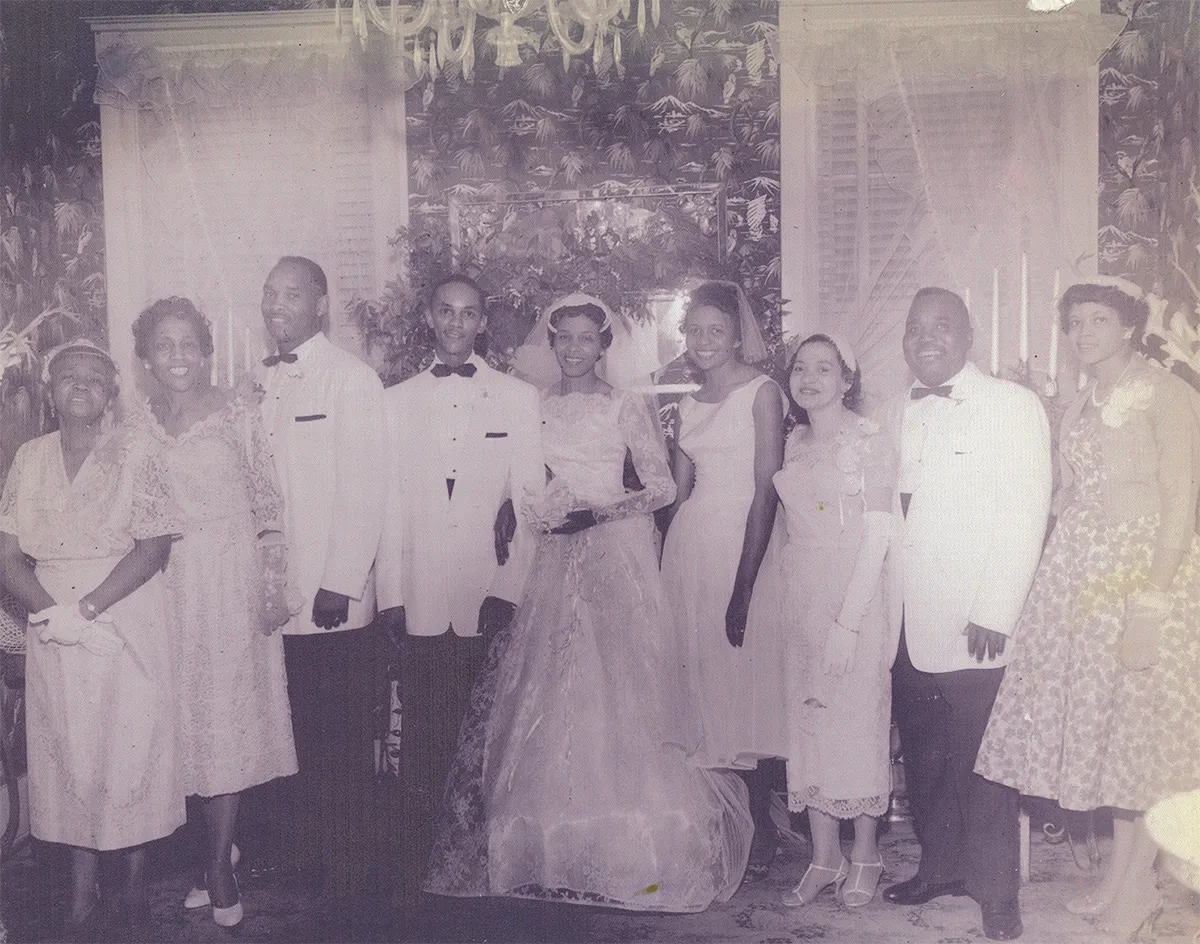
The Lorraine before it was a memorial — a wedding at the motel. The museum is careful to show the building as a place people lived their lives.
Soul food, breakfast, and 3 am
Soul food is the other pillar here and shares the same neighbourhoods, sometimes the same pits. Memphis also takes breakfast seriously in a way visitors routinely skip, and its music culture keeps kitchens open later than any other Southern city on this route.
For the camera
Memphis is a neon city, and March mornings are cool and often misty on the river. These six sit within a short drive of each other — the marquee, the pyramid, the trolley, two hundred autographed guitars, a million tulips and an old-growth forest.
Where to sleep
Parking is the deciding variable here, not the room rate. Across seven nights the gap between a free lot and valet-only is $175–245 for one car — about $50 a head.
| Base | Best for | On the doorstep | The catch |
|---|---|---|---|
| Downtown / Beale St | Everything inside a 15-minute walk | Rendezvous two blocks; Central BBQ; B.B. King's; the Orpheum; the Civil Rights Museum 10 min south | Loud until 3 am at weekends — ask for an interior room above the 6th floor. Parking $18–30/night |
| South Main Arts District | Character, and the best boutique hotels in the city | The Civil Rights Museum two blocks; the Arcade diner since 1919; Gus's fried chicken; Earnestine & Hazel's | Quiet after 11 pm — you walk or drive back for live music. Mostly paid valet |
| Cooper-Young / Midtown | Renting a whole house and cooking breakfast | The Bar-B-Q Shop a 10-min walk; Central BBQ on Central; Memphis Made Brewing; Goner Records | Beale Street is a 15-min drive or a $12–15 rideshare most nights |
At 11 am and 5 pm sharp, five ducks ride the elevator down at The Peabody, walk a red carpet across the lobby and get into the fountain. It has happened daily since the 1930s, it is free to watch, and it is gloriously silly. Arrive fifteen minutes early for a spot.
Highway 61, into the Delta
Drive south out of Memphis on US-61 and within twenty minutes the world goes flat: cotton and soybean to the horizon, freight tracks running beside the road, and not much that looks like anything. That first impression flips the moment you are standing in downtown Clarksdale, 76 miles and about an hour and thirty-five minutes south. This is where the music you have been hearing on Beale Street was actually made — where Muddy Waters was born, where Robert Johnson supposedly traded his soul at a crossroads, and where the barbecue starts bleeding into something older and sweeter, served alongside hot tamales.
Do it as a day and you get the Gateway to the Blues Museum in Tunica on the way down, lunch and live music at Ground Zero Blues Club — a proper juke joint in a 1900s cotton warehouse, corrugated metal, mismatched chairs, dollar bills stapled to the ceiling, co-owned by Morgan Freeman — the Muddy Waters cabin at the Delta Blues Museum, and the Crossroads sign with Abe's Bar-B-Q sitting right behind it.
Do it as an overnight and you get the thing that actually justifies the drive: a night at Red's Lounge, widely held to be the most authentic surviving juke joint in Clarksdale. Low ceiling, neon, no sign out front — you find it by the smell of the grill. Cash only, no video. Longtime owner Red Paden hosted T-Model Ford and Big Jack Johnson here for decades; his son Orlando has kept it going. Sleep at the Shack Up Inn, genuine sharecroppers' shotgun shacks relocated onto the old Hopson Plantation and converted into rooms ("The Ritz, We Ain't" — adults 25+, $80–250), and you can catch the Delta Blues Museum the next morning, which most day-trippers miss because it shuts at 4:30 and closes Sundays.
The regional dish is not brisket. It is the Delta hot tamale — masa-wrapped spiced pork or beef, hand-rolled, steamed in husks and served wet with chili and cheese, a tradition carried in by early-twentieth-century Mexican migrant cotton labour and absorbed into Black and Southern home cooking. The University of Mississippi's Southern Foodways Alliance formally mapped the Hot Tamale Trail from Tunica to Vicksburg. Abe's, Ground Zero and Hicks' all serve them.
💡 Carry small bills — Red's and several museums are cash-only and keep informal hours. Gas up in Memphis; options thin out fast on 61. And know that Clarksdale's biggest weekend, the Juke Joint Festival, is the second week of April — a few weeks after a March trip, which is good news for lodging prices and bad news for anyone who wants 100 blues acts on twelve free stages.
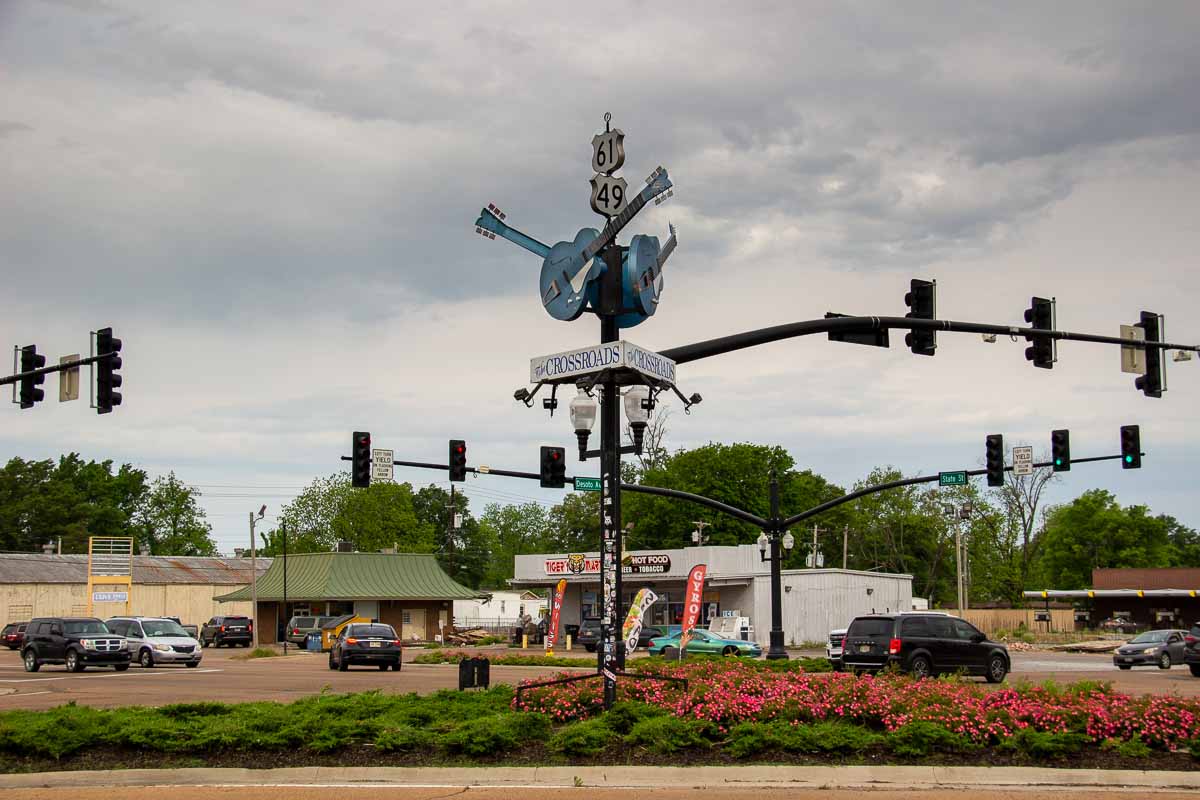
The Crossroads, Highways 61 and 49. Abe's Bar-B-Q — open on this corner since the 1920s — sits directly behind it, with a plaque out front joking that while Robert Johnson was dealing with the devil across the street, Abe Davis was praying to Jesus for his sauce recipe.
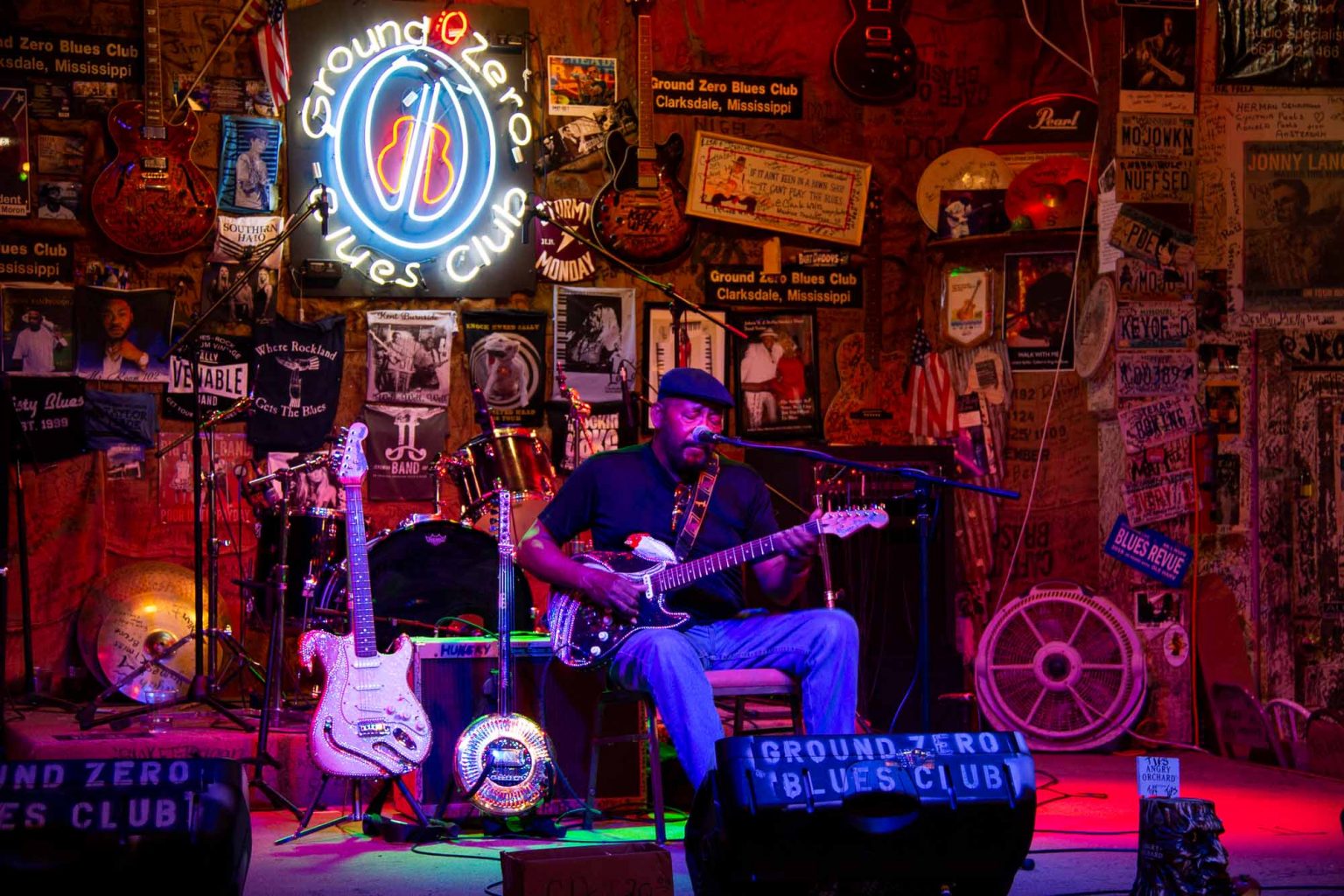
Super Chikan at Ground Zero Blues Club.
The long haul
This is the leg people dread and then remember. Nine or ten hours down I-40 to I-30 to I-35 is genuinely too much for one day with four people and a trip's worth of eating still ahead — but it also happens to run through three more barbecue traditions in a single tank of gas. Arkansas loosens up: whole hogs, tangy vinegar-and-mustard sauce, and a parallel obsession with melted cheese dip that locals will argue about as fiercely as they will about pork. East Texas along I-30 is "sign barbecue" country, where joints advertise on billboards for miles — a tradition serious enough that Texas Monthly built a green/yellow/red rating system purely to judge which exits are worth taking. Then, somewhere around Waco, the whole thing becomes beef.
Break it at Hot Springs
Little Rock and Hot Springs sit almost exactly at the midpoint — Memphis to Little Rock is about two and a half hours, and Little Rock onward to Dallas is another five to five and a half. Either makes the split work, but Hot Springs is an actual destination rather than a bed: an urban national park where eight ornate early-1900s bathhouses line Central Avenue over the natural thermal springs. Two of them, the Buckstaff and the Quapaw, still let you soak. The others hold the visitor centre, a cultural centre, a hotel — and a brewery that is the only one inside a US national park and the only one anywhere brewing with thermal spring water, which comes out of the ground at a steady 143°F.
It was also, for decades, an open-gambling town: The Ohio Club is the oldest continuously operating bar in Arkansas and a former speakeasy and casino that drew Al Capone, Bugsy Siegel and Lucky Luciano. It does live music most nights and a locally famous burger. In March, Garvan Woodland Gardens on Lake Hamilton is at its best — 210 acres of tulips and azaleas, plus Anthony Chapel, a soaring wood-and-glass structure by E. Fay Jones, a student of Frank Lloyd Wright. Go to the chapel first thing; weddings close it off later.
💡 If your group would rather have history than hot water, overnight in Little Rock instead: Central High School National Historic Site, where the Little Rock Nine desegregated the school in 1957 under armed federal guard, is free and ranger-led, and the Clinton Presidential Library and the River Market District are ten minutes away.
What to eat between here and Texas
In driving order, west out of Memphis. The one unmissable stop is Naaman's in Texarkana — Texas Monthly's barbecue editor rated it the top "exit here even with a full tank" pick on the entire I-30 crawl from Texarkana to Fort Worth.
And what to do when you stop
Cheese dip — not queso, and locals insist on the distinction. Little Rock claims to have invented it in 1935 at Mexico Chiquito, predating the national spread of Tex-Mex queso, and it now turns up at barbecue joints, burger stands and breweries alike; the city hosts a World Cheese Dip Championship. And fried pies — hand-held fried turnovers stuffed with fruit, cream or cheesecake filling, best from Morrison's trailer in Hot Springs, where the popular flavours sell out.
Somewhere between Texarkana and Waco the food changes underneath you. The sauce thins out and then vanishes; the pork gives way to beef; the plate becomes a sheet of paper. Stop at the Czech Stop in West, Texas — a bakery behind a Shell station, 600 visitors a day — for kolaches and their savoury cousin the klobasnek. It is the same Czech immigrant thread that built Central Texas barbecue, and it is the last thing you eat before Austin.
Austin
Austin doesn't do barbecue the way Nashville and Memphis do, and that gap is the entire reason to land here last. After a week of sweet tomato sauce and pork, Central Texas hits like a change of key: beef, salt, pepper, post oak, and a pitmaster who would rather you didn't reach for the bottle. The scene grew out of the same nineteenth-century butcher shops in the towns ringing the city, then layered on decades of trailer experimentation and outright ambition — Aaron Franklin's 2009 trailer didn't break with Central Texas orthodoxy, it mastered it, and turned the queue itself into a ritual. Austin is also the best-fed city on this route in every other direction: the breakfast taco is its daily bread, and after seven days of smoke you will want one badly.
The Austin pits
Here is the honest advice about Franklin: it is as good as its reputation, and the line is real — arrive by 8 or 9 am Tue–Thu for a two-to-three hour wait, or 6 am at a weekend for four to five. If any of you can plan six weeks out, the 5 lb to-go pre-order skips it completely. If not, the city's best all-around barbecue experience is arguably LeRoy and Lewis anyway, and Terry Black's will feed four people a full tray at 8 pm on a Tuesday with no drama at all.
Closed Mondays: Franklin. Wed–Sun only: la Barbecue. Open daily until 9 or 10 pm: Terry Black's — rare and useful. Trailer operations like la Barbecue and Parish shift days seasonally; check Instagram the week you travel. If you want the whole Texas Trinity in one tray — brisket ordered moist, a beef short rib, and a snappy sausage link — LeRoy and Lewis or Interstellar will give it to you with a 20-to-45-minute wait instead of five hours. And if brisket fatigue is genuinely setting in by day seven, KG BBQ's pomegranate-glazed, za'atar-dusted ribs are the most interesting thing being smoked in this city.
The five with no marathon queue
Every one of these is excellent, and none of them will cost you a morning. Two hold Michelin recognition, one has no brisket on the menu at all, and one smokes out of a converted church.
Live Music Capital of the World
Austin earns the title most honestly on two blocks of Red River, where five or six bands play simultaneously within a five-minute walk and the locals outnumber the tourists. But the non-rock side is the one that fits this trip: a 1955 roots room on South Congress and a 1964 honky-tonk with a sticky floor and free two-step lessons.
Daylight, water and 1.5 million bats
You will need to walk some of this off. March is the best month for all of it: green grass, comfortable patios, and the bat colony beginning to return from Mexico.
Murals, the dome and the bluebonnets
Austin's street art has genuine staying power, and by the back half of March the state flower is arriving. A focused 90-minute circuit covers the first three; the fourth is a twenty-minute drive south.
Up to 1.5 million Mexican free-tailed bats roost in the crevices under the Congress Avenue Bridge and spiral out at sunset in a ribbon that can take 20 to 45 minutes to fully emerge. In March you are catching the leading edge — the colony is only just back from Mexico, and the full spectacle is a July-and-August thing. It is still worth 45 minutes of your evening, it is free, and it is completely wild. Stand on the south side of the bridge on the hike-and-bike trail, or at the Statesman observation area below. Check austinbats.org for current emergence reports the day before.
Breakfast tacos, and the antidote to smoke
The breakfast taco is the most Austin eating occasion there is — two or three tacos and a coffee from a trailer at 7 am, $6 to $10 total, eaten standing up. Get it right by going early; the best trailers are running low on fresh tortillas by 10. And order the Bob Armstrong Dip at Matt's El Rancho before anything else reaches the table.
Where to sleep
One decision drives everything: how close do you want to be to the barbecue? East Austin wins on that, and it is also where the food-and-music scene is most alive right now.
| Base | Best for | Barbecue on foot | The catch |
|---|---|---|---|
| East Austin (E 6th / César Chávez) | This trip, straightforwardly | la Barbecue 0.5 mi / 10 min walk · Franklin 1.2 mi | E 6th gets rowdy late; some blocks still transitioning. Driveway parking at rentals |
| South Congress (SoCo / Music Lane) | Character, and the most photogenic strip in the city | Terry Black's 0.4 mi / 8 min walk | Trendy means expensive; intense during SXSW; less late-night honky-tonk |
| Downtown / Rainey St | Maximum live music without a car | None — Franklin and la Barbecue need a drive | Paid garages only, $25–45/night, and they fill during SXSW. Noisiest and priciest |
For four people sharing during festival week, a whole-unit rental beats four hotel rooms on cost, on parking, and on sanity — and East Austin has plenty of three- and four-bedroom houses within walking or cycling distance of la Barbecue and the E 6th music strip. Rentals do surge three to five times off-peak rates during SXSW, so the advantage is availability and parking as much as price. Whatever you book, reserve the parking space when you reserve the room.
Lockhart, where it started
Lockhart is the only town in America where the state legislature felt obliged to codify the obvious. In 1999, and again in 2003, the Texas House and Senate each passed resolutions naming it the Barbecue Capital of Texas. The title is not ceremonial — it describes a place where four institutions have been smoking beef over post oak continuously, in the same buildings, in the same brick pits, in some cases for more than a century, with the fires never fully going cold.
What makes it singular is that none of this was ever meant to be a cuisine. In the 1800s, German and Czech immigrants opened meat markets here. Without reliable refrigeration they smoked whatever cuts hadn't sold by week's end — a solution to waste, not a culinary project. The meat was good enough that people started coming in for it specifically, and the accident hardened into tradition. At Kreuz Market (1900), Smitty's (in the same building since 1924) and Black's (1932), you are not eating a restaurant's interpretation of that history. You are eating the history.
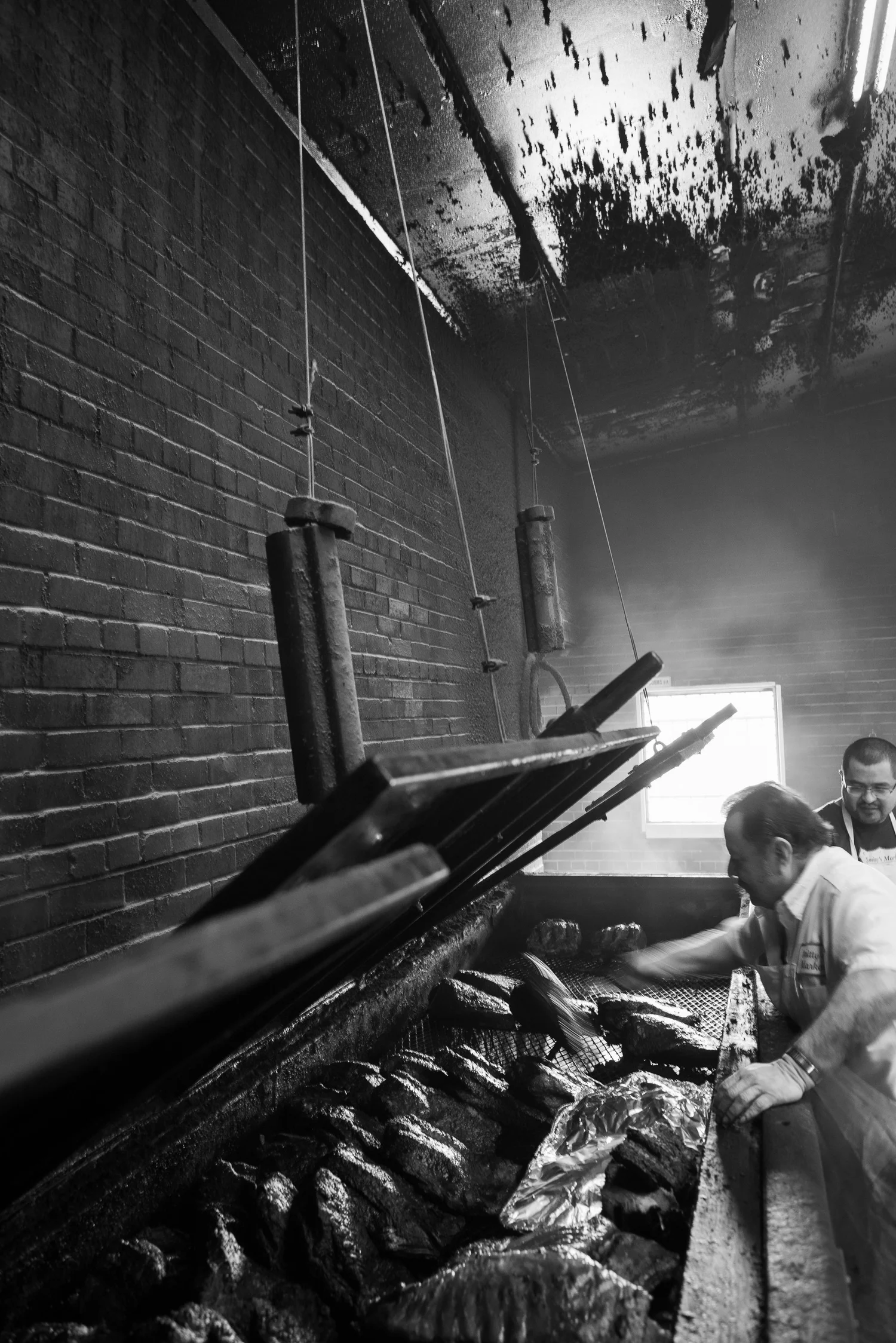
A century of soot on the ceiling at Smitty's. "Walking through the long hallway feels like entering the queue of a meat-themed Disney ride" — The Infatuation.
The feuds that multiplied the town
Lockhart's family arguments are as much a part of the story as the pits. A 1999 dispute over a building lease split Kreuz from Smitty's — the family physically dragged the burning coals a quarter-mile up Colorado Street to the new building rather than let the fire go out, and Smitty's kept the original 1924 pits. A later name dispute between an uncle and his nephews split Black's from Terry Black's. The net effect is that Lockhart now has more great barbecue than it did before the fighting started.
And it is no longer only barbecue. A wave of post-pandemic arrivals — a cocktail bar, a natural wine shop, a chef-driven café — came for the cheap rents and the gravitational pull of the pilgrimage crowd. The institutions are still the reason to drive down. The newcomers are why you now have somewhere to drink afterwards.
All four legacy joints open around 11 am and the prime cuts — brisket, beef ribs, short rib — are gone early-to-mid afternoon. On a Sunday, Smitty's closes around 3 pm. Bring cash: Smitty's has historically been cash-or-check and Kreuz still prefers it. Two or three joints in one visit is the right ambition for four people; order half-pounds and share.
The four pits, and the new one
Kreuz and Smitty's are the classic pairing — same family story, a mile apart, and the sharpest single comparison on the trail. Add Black's for the dining-room contrast and the forearm-length beef ribs, or Terry Black's if you want the best all-round tray in town. Barbs is the new school, and it is on the Texas Monthly Top 50.
An hour on the square
Do not just eat and drive back. The courthouse square is one of the best-preserved in Texas, and after two pounds of brisket you will want to walk.
9:30 am leave Austin south on US-183. 10:15 coffee at Chaparral on the square — everyone in Lockhart passes through at least once a day. 10:45 the pit rooms at Smitty's and Kreuz while the pitmasters are still working and the light through the hallway windows is good — this is the photograph of the whole trip. 11:15 eat, in two or three rounds. 1:30 the courthouse, the Clark Library's stained glass, Big Dog Neon's window. 2:30 a Whata-Frozen at Old Pal, which opened specifically because there was nowhere to drink in the afternoon after barbecue. 4:00 back to Austin in time for the bats.
If you have one more day: Taylor, Elgin and Lexington
Lockhart is not the only town in the ring, and the other three do not sit on one tidy loop with it — so treat them as an alternative day rather than an extension. Louie Mueller Barbecue in Taylor, 40 minutes north, opened in 1949 and won the first James Beard Award ever given to a barbecue joint; its pepper-crusted beef short ribs are the reference standard, and it is cash only. Elgin, 30 minutes east, is the origin point of the sausage style — Southside Market has been making "hot guts" links since the nineteenth century, and Meyer's is next door. And Snow's in Lexington, an hour east, is the most famous Saturday-only barbecue in Texas: pitmaster Tootsie Tomanetz, a Netflix Chef's Table subject, opens before dawn and is routinely sold out before 10 am. If one of your Austin days is a Saturday and the group is willing to leave at five in the morning, that is arguably the best single meal available on this entire trail.
The Hill Country add-on
If you can add a night at the end, point the car an hour west into the Texas Hill Country — the deliberate palate cleanser after seven days of smoke. Fredericksburg was founded in 1846 by 120 German immigrants and still has 700-plus historic structures and 150-odd locally owned shops on a Main Street with no chains on it. Eleven miles southeast is Luckenbach, a "town" of essentially three buildings — a general store and bar, a dance hall, and nothing else — made permanently famous by Waylon Jennings' 1977 hit and by Hondo Crouch, the raconteur who bought the whole place for $29,000 in 1971 and turned it into a magnet for outlaw country. Pickers' circles start spontaneously on the back porch under the live oaks from mid-afternoon; a beer is a few dollars and a hay bale is free.
The barbecue does not stop out here, it just gets older and more rural. Cooper's Old Time Pit Bar-B-Que in Llano is the original of the now-multi-city name, and the ordering ritual is the draw: you queue outside at the open mesquite pits, point at your meat, get it weighed, and eat at long communal tables. Texas's own state tourism board builds its four-day barbecue road trip around exactly this pairing — Cooper's for lunch, then Enchanted Rock in the afternoon to walk it off. That's a 425-foot pink granite dome, the second largest of its kind in the country, with a 0.8-mile Summit Trail straight up the rock face to 360-degree views. Reserve the day-use permit in advance — mandatory at weekends and school breaks, strongly advised otherwise, because the park closes entry when it fills. Coming back toward Austin, Opie's in Spicewood has a show pit where you pick cuts off the fire, plus an off-menu Coca-Cola cake.
The other axis out here is wine, and it is no longer a novelty: the thirty-mile stretch of US-290 between Johnson City and Fredericksburg has gone from a handful of wineries to around fifty. William Chris Vineyards in Hye is the only Texas winery ever named to the World's 50 Best Vineyards list and pours 100% Texas-grown fruit — a real point of pride in a region where importing out-of-state grapes is common. Pedernales Cellars in Stonewall is a sixth-generation Texas family operation on 145 oak-shaded acres above the Pedernales River valley, known for Tempranillo and Viognier and an underground cellar tour. Both expect reservations, especially Friday to Sunday. Three or four wineries in a day is, per Texas Monthly's own writer attempting it, "ambitious" — and you will need a designated driver or a hired car.
💡 One honest caveat: bluebonnets are not reliably out yet in March. Peak is late March into mid-April, with the lower elevations near Blanco blooming first and Fredericksburg a couple of weeks behind. The Willow City Loop — a narrow 13-mile ranch road north of town, the iconic Hill Country scenic drive — is worth it either way, but it will be green rather than blue if you come early in the month. Old Tunnel State Park's bats are a May-to-October affair; skip it in March unless you want the trail.
The map
The dashed line is the route in driving order, Nashville to Lockhart. The thinner, quieter lines are the optional legs: the Delta south of Memphis, the Lynchburg whiskey run out of Nashville, the Hill Country west of Austin, and the Taylor–Elgin–Lexington ring. Toggle the categories to strip the map back to just the pits.
Sources & credits
Everything in this guide is drawn from the sources below — restaurant critics who ate the food, documentary photographers who stood in the pit rooms, official tourism boards, national and state park services, and the venues themselves. Individual place cards link to their own sources.
Barbecue & food criticism
- The Infatuation — The Best BBQ in Nashville
- The Infatuation — Nashville Hot Chicken Power Rankings
- The Infatuation — The Best BBQ Spots in Austin
- The Infatuation — The Best BBQ in Lockhart
- Eater — The Best Restaurants in Memphis
- Eater Nashville — The Essential 38
- Eater Austin — Where to Eat and Drink in Lockhart
- Eater Austin — Best Road Trip Restaurants From Austin
- Eater — An Epic Barbecue Tour of Texas
- Eater Austin — Barbecue in the Hill Country
- Southern Living — 8 Must-Visit BBQ Joints in Memphis (Robert F. Moss)
- Texas Monthly — Top 50 BBQ Joints
- Texas Monthly — Highway BBQ: I-30 from Texarkana to Fort Worth
- Texas Monthly — Smitty's Market, Lockhart
- Texas Monthly — The Reinvention of a Texas Town
- Texas Monthly — Texas Wine Is Growing Up
- Texas Monthly — Can Luckenbach Be Saved?
- Southern Foodways Alliance — The Hot Tamale Trail
- Southern Foodways Alliance — Kreuz Market oral history
- Southern Foodways Alliance — McClard's Bar-B-Q oral history
- Eater — Nashville Hot Chicken: Invented by Prince's
- Nashville Scene — Pork Is King, Sauce Is Boss
- I Love Memphis — Must Eat BBQ in Memphis
- Tennessee Tourism — BBQ Places in Memphis
- KXAN — How Did Lockhart Become the Barbecue Capital of Texas?
- The Waco Things — The Best BBQ in Waco, Ranked (Kelsey Kennedy)
- Feastio — Eating at Goldee's BBQ, Fort Worth (Dave Lee)
- Arkansas Times — The Smoked Meat Pleasures of Naaman's
- Tie Dye Travels — Sims Barbecue (Kat Robinson)
- Somewhere in Arkansas — Best Cheese Dip in Little Rock
- Atlas Obscura — Czech Stop & Little Czech Bakery
- Texas Monthly — The Most Important Taco of the Day
- The Local Palate — The Essential Nashville
- Parts Unknown — When All You Need Is a Meat-and-Three
Photography & place
- Rob Hammer Photography — Smitty's Market
- Rob Hammer Photography — Kreuz Market
- Camels & Chocolate — The Natchez Trace Parkway in Tennessee (Kristin Luna)
- Camels & Chocolate — An Afternoon in Lynchburg
- Tilted Map — Mississippi Blues Trail Guide (Ketti Wilhelm)
- Garden & Gun — An Unforgettable Night at Red's
- Pictures & Words — Nashville Photo Spots (Caroline Ikeji)
- Feelin' Fancy — Nashville Murals (Rachel Mahar)
- StyleBlueprint — Nashville's Cherry Blossom Walk (Liza Graves)
- NashSee — The John Seigenthaler Pedestrian Bridge
- Dym Abroad — Photogenic Places in Memphis (Dymphe)
- I Love Memphis — Capturing the Soul of Memphis
- We Are Memphis — Top Photo Spots
- Gribblenation — Walking Across the Mississippi in Memphis
- Two Scots Abroad — Best Places to Take Pictures in Austin
- The Whole World Is a Playground — Austin Photo Spots
- The Austin Things — Where to Take Bluebonnet Pictures (Kelsey Kennedy)
- The Austinot — Day Trip to Lockhart (Samantha Saenz)
- Sabah — A Day Trip to Lockhart
- The Mountains Please — Hot Springs National Park Itinerary (Scott)
- Travel on the Reg — Three Days in Little Rock (Agnes Groonwald)
- Passport & Stamps — Nashville to Franklin & Leiper's Fork
- Traveling Mitch — Things to Do in Leiper's Fork
- Smithsonian Magazine — Photos of Nashville
- Exploration Vacation — Cooper's BBQ, Llano
Official sources — parks, venues, tourism boards
- National Civil Rights Museum
- Sun Studio
- Stax Museum of American Soul Music
- Graceland
- Ryman Auditorium
- Memphis Tourism — March in Memphis
- Memphis Tourism — Wild Bill's Juke Joint
- Memphis Tourism — Beale Street
- Memphis Tourism — The Memphis Flyway at Tom Lee Park
- Beale Street — Silky Sullivan St Patrick's Parade
- Irish Network Nashville — St Patrick's Day Parade & Festival
- Visit Music City — Nashville
- SXSW
- Visit Austin — 20 Iconic Austin Music Venues
- Visit Austin — Day Trip: Lockhart
- Visit Austin — How to Experience Austin's Bats
- City of Austin — Barton Springs Pool
- National Park Service — Natchez Trace Parkway
- National Park Service — Hot Springs
- Texas Parks & Wildlife — Enchanted Rock
- Texas Parks & Wildlife — Old Tunnel
- Jack Daniel's Distillery — Tours
- Loveless Cafe
- Franklin Barbecue
- Visit Clarksdale
- Delta Blues Museum
- Juke Joint Festival
- Visit Fredericksburg
- Luckenbach, Texas
- Travel Texas — Four-Day BBQ Road Trip
- Little Rock CVB — The River Market District
- Fredericksburg Wine Road 290
Photographs
Photographs are hotlinked from the pages listed above and remain the property of their photographers and publishers — among them Rob Hammer, Casey Irwin, Kelli Dirks, Richard Casteel, Nicolai McCrary, Eliza Kennard, Kristin Luna, Ketti Wilhelm, Christine Lozada, Caroline Ikeji, Rachel Mahar, Liza Graves, Samantha Saenz, Kelsey Kennedy, Taylor Tobin, Cat Cardenas, Justin Fox Burks, Craig Thompson, Alex Shansky, Allen Gillespie, Marissa Strang, Julian Harper, Dave Lee, Kat Robinson, Scott of The Mountains Please, Agnes Groonwald, Arnold Wells, Chad Wadsworth, Ismael Quintanilla III and Steve Rawls. Per-image credit appears in the caption when you open any photograph. Nothing here is offered for reuse — follow the source link if you need rights.
A note on accuracy
Prices, opening days and festival dates in this guide were current at the time of research and will drift — barbecue joints in particular change hours seasonally and several are family operations without a reliable published schedule. Confirm the week you travel, especially: SXSW's exact dates; the Nashville and Memphis St Patrick's parade dates; Payne's, Cozy Corner, A&R and Interstate's opening days; la Barbecue and Parish's trailer schedules; Barbs B Q's days in Lockhart; Barton Springs Pool cleaning closures; the Natchez Trace bridge's maintenance status; and the Enchanted Rock day-use permit system. Map pins were geocoded from street addresses — a few are accurate to the address rather than the front door.
Coordinates and basemap: map data © OpenStreetMap contributors, available under the ODbL licence. Basemap tiles © OpenFreeMap.